Thursday, September 27, 2012

Should Dr. Man Mohan Singh Visit Pakistan Now ? Part - I


The recently concluded foreign ministers’ meeting between India and Pakistan at Islamabad saw the Pakistani side demanding yet again a visit by the Indian Prime Minister Dr. Man Mohan Singh to that country in November coinciding with the Guru Purnima, a holy day for the Sikhs, to which community the Indian Prime Minister belongs. The crescendo has been building up for a while now and was brought up by President Asif Ali Zardari himself when he came over to India in June, 2012 ostensibly to pay obeisance at the Ajmer Sharif dargah of Khwaja Moinuddin Chishti, a holy place for Sufi Muslims of the Indian subcontinent. The sudden and an inexplicable visit of President Zardari to Ajmer Sharif, appears in hindsight, to be for no ostensible reason other than eliciting a reciprocal religious visit by the Indian Prime Minister through subtle pressure.

Though speculations have abounded as to why such an incessant request, even demand, has been made to the Indian Prime Minister when there has been apparently no significant progress in the on-going dialogue between the two nations, ranging from possible political gains to the much beleaguered Pakistan Peoples' Party (PPP), to mounting American pressure in view of the looming withdrawal of the International Security Assistance Force (ISAF) from Afghanistan and therefore a need to forge a regional consensus, one is not certain about the real reason behind this request. The political dimension appears to be a more plausible reason. Recently, Pakistan delayed the signing of the documents for the new 'liberalized visa regime' when the Indian Home Secretary visited Islamabad,  by claiming that only political leaders should sign such an important agreement. Thus, Pakistan was even willing to wait longer for something that it has been vociferously demanding for many years now, just in order to get some political mileage out of this event.

The non-stop demand for the Indian PM's visit to Pakistan also appears, therefore,  to be a political stunt by the ruling PPP which otherwise is hopeless about retaining its rule after the elections which are just around the corner. Coming in the wake of a series of D-Days for the PPP government in the form of pronouncements from the Supreme Court of Pakistan, one can only conclude that the visit of an Indian Prime Minister is desperately being sought to bolster the sagging fortunes of the ruling party. The announcement of an agreement on withdrawal of troops from the Siachen glaciers, for example, could contribute significantly towards a turnaround of fortunes for the PPP. Since June, 2005 when Mr. Man Mohan Singh visited Siachen, he has been determined to work out a deal to withdraw Indian troops from the advantageous and commanding positions that they have enjoyed along the Saltoro Range. This obsession by the Indian Prime Minister to commit a harakiri in Siachen is of course, music to Pakistani ears and they have been massaging him and his advisers to agree to Pakistani promises of good behaviour which is worth much less than anything written on a sandy beach washed by smashing tidal waves. Since that is something that the Pakistani Army also demands, especially after the recent Gyari incident, there is a rare approval of the PPP by the Army at least on this issue. Since Indian Prime Ministers have regularly conceded Pakistani demands in one-on-one meetings, it may be Pakistan's calculation that if Mr. Man Mohan Singh visits Islamabad they may have a chance of striking a deal on Siachen favourable to Pakistan.
Whatever may be the reason or reasons for Pakistan to demand this visit, we need to debate whether such a visit would do any good to India at all. Some Indian analysts have opined that such a visit must be undertaken now because they see no deleterious effect at all while there is a possibility of a progress, even if not a breakthrough, in one or more of the issues such as Sir Creek or Siachen or the Indus Water sharing disputes. At least one of them has cited how the meeting between Pandit Jawaharlal Nehru and the then Pakistani Prime Minister Liaquat Ali Khan led to the Nehru-Liaquat Pact of  April 8, 1950 on the protection of the rights of religious minorities in both the countries in the wake of continuing violence after a genocidal Partition. Then, there is a reference to the Indus Water Treaty(IWT), signing for which, Pandit Nehru went to Karachi (September, 1960) and met Field Marshal Ayub Khan. The visit of Rajiv Gandhi to Islamabad (December, 1988) is also thrown in as a proof of a meeting that resulted in instituting a mechanism to exchange data about nuclear installations in either countries that would not be attacked in case of a war, thus paving some way for nuclear Confidence Building Measures (CBMs). Last, but not the least is the citation of Atal Behari Vajpayee’s bus-trip to Lahore (February, 1999) that realized a long-standing dream of bus travel and border trade between the two divided portions of Kashmir. The point being made by such an analysis is that summit meetings between Indian & Pakistani Prime Ministers can lead to some positives even if not a breakthrough is achieved resolving the ‘enduring hostility'. But, is such a conclusion correct and warranted ?  No, not at all, in my opinion.

Between circa 1972 and 1989 (when Pakistan-sponsored terrorism erupted in all its glory in India eventhough Pakistan has been sponsoring terrorism in J&K since c. 1947 itself), the Indian Prime Minister  and his / her Pakistani counterpart had met eight times in either countries. I have not included the meetings between them in third countries which account for another eight such meetings. In spite of these meetings, cross-border terrorism of the worst kind was inflicted upon India by Pakistan. Since circa 1990, there have been many more such meetings, and though some progress has indeed been made, the reasons for which are the dire economic necessity of Pakistan and the enormous pressure exerted on both countries by the USA, the fundamental differences continue to exist and have not been touched at all. And, Pakistan continues to pummel India with terrorism in all parts of India.


Less than two months back, there were serial bomb blasts in Pune and much fatalities, maiming and damage were averted because of pure luck: rain and a failed electronic circuitry. In July 2011, the most sought after target in India, Mumbai, was rocked once again by three serial bomb blasts that killed over two dozen people and maimed 150. In December 2010, the Varanasi temple was bombed and a toddler was killed. In February 2010, the Best bakery in Pune was bombed, again killing a dozen and injuring over 50. Yet another attack was exactly a year ago almost to this day at the Delhi High Court which killed a dozen people and injured over 70. How quickly we have forgotten all these ! May be, we no longer classify such attacks where the fatalities are less than a hundred, as terror attacks. These are cases which happened. We will never know how many attempts were nipped by the intelligence agencies. So, Pakistan believes that it needs to continue the terrorism pressure on India even while it tricks her into summit talks to get more and more concessions from the very big neighbour. The demand has always been that India must be more generous, something to which the Indian Wagah Kandle Kissers (WKKs) have regularly subscribed too.
Above anything else, we have to recognize one grand difference (among many others) between the way Pakistani and Indian leaders approach India-Pakistan relationship and the way to go about resolving disputes. Pakistan has always been governed by a powerful central leader (Jinnah, Liaquat Ali Khan, Z.A.Bhutto or military dictators from the front seat or Chiefs of Army Staff from the backseat). I have not included either Ms. Benazir Bhutto or Nawaz Sharif or Yousuf Raza Gilani in the list because while they were powerful (at least the first two), they were circumscribed in their handling of relationship with India by the powerful Army. These powerful central leaders (Jinnah, Liaquat Ali Khan or Z.A. Bhutto) and military dictators or the Army Chiefs (COASs) were answerable to none and handled the India-situation as they liked. Their goal was tactical and always to bring India down to her knees at any opportunity and they worked towards that goal, mindless of consequences. If the Pakistani Army sensed any small change in the government's policy from the conflict-mode to a peace-mode, it immediately stepped in to nip such changes in the bud. The characterization of Ms. Benazir Bhutto as a 'security risk' during her first term in office as the Prime Minister is an example. That she atoned for this lapse in her second term by vigorously supporting jihad against India is another matter though.

If a servile relationship with Western powers were to be forged, Pakistan was willing to do that without much of a debate. If jihadi Islamism were to be nurtured, they were happy to do so without worrying about the backlash. If a capitalist Western friend were to be substituted by a communist country at the height of Cold War even while being part and parcel of the Western military alliances against spread of communism, because that suited Pakistan at that particular moment, they did so without batting an eyelid. If thousands of square kilometres of land were to be ceded to China just so that friendship could be developed with that country to target India later, they did so without much of an internal debate. All these were explained away casually as decisions taken in the 'best national interests' to Pakistanis. Generally, the people of Pakistan including opposition political parties never questioned such short-term deals because these were acceptable tactics against  the mortal kafir enemy, India. They were never discussed in the Parliament firstly because there was no worthwhile Parliament most of the time (as military dictators have ruled for almost half the life of Pakistan) and even when there was one, everybody understood that such important foreign policy decisions would have been taken by the Pakistani Army and it was futile and even downright dangerous to discuss such 'sensitive' decisions. Even a few feeble attempts to bring the Pakistani Army and its notorious intelligence wing, the ISI, have been failures to this day.
Indian leaders cannot behave like that and have not behaved like that. They are answerable to the collective responsibility of the Cabinet, to the elected representatives in the Parliament and to the people at large. They have to and they do respect international conventions and agreements. A country encompassing roughly one-sixth of humanity within itself cannot take decisions without bothering about the consequences. An Indian leader cannot simply visit Islamabad and take a decision on the spur of the moment. The Indian Cabinet would authorize the Prime Minister for certain decisions before embarking on a summit meeting and he or she has to keep himself/herself strictly to that script. There have been a few exceptions like when Dr. Man Mohan Singh went out of his way to please and placate a fellow Punjabi, Yousuf Raza Gilani, by almost implicating India in Pakistan's Balochistan mess at the Sharm-el-Sheikh meeting in mid-July 2009. This caused such a massive uproar within the country and within his own Congress party, that a huge damage control exercise had to be resorted to contain the fallout. But, such incidents are rare and almost unheard of even when a steam-rolling and all-powerful Nehru was in charge of the Ministry of Foreign Affairs.
Let us also see if the Nehru-Liaquat Pact or the IWT or even the Nuclear CBM between Rajiv Gandhi-Benazir Bhutto came about just because the two Prime Ministers met or they met just to sign a deal that had been worked out after extensive preparatory work between the secretaries and ministers of both the countries.
Only Nehru-Liaquat Pact of April 1950 could qualify as something that was signed in a very quick time, without elaborate discussions. However, the exigencies of the grave situation were such that a quick action had to be taken and the Pact was a result of that. Why such a haste, one may ask ? I would only quote from the resignation letter tendered by a federal Pakistani minister and one of the staunchest Muslim League supporters, Jogendra Nath Mandal, in the wake of the 1950 genocide of the Hindus in East Pakistan. Mandal, a Bengali, was a freedom fighter and a Harijan (nowadays referred to as Dalits) leader, but was brain-washed by the Muslim League and enticed to support its causes and stay in Pakistan. Pakistan desperately wanted the services of these depressed people as no Muslim was expected to do the menial jobs in their cities and they feared that if Mandal left, the people would also follow him. In her wonderful book, 'Empires of the Indus', Ms. Alice Albinia recalls a similar incident with another Harijan leaders in Karachi in c. 1948. Mandal did not realize that the Muslim league had already accorded 'third-class citizenship' to the Harijans. Therefore, he received the shock of his lifetime one day in February, 1949. When Mandal raised the fear of the minorities during a discussion in the Constituent Assembly over the introduction of the Objectives Resolution, he was told by Maulana Shabbir Ahmed Usmani, the sponsor of the Resolution, that as a Hindu he should not have been in the first place in the cabinet of a Muslim nation and that he should be paying jizya. Mandal simply shut up. Now, let me quote a portion of Mandal's resignation letter:
It must be noted that stories of a few incidents of communal disturbance that took place in West Bengal as a sort of repercussion of the incidents at Kalshira were published in exaggerated form in he East Bengal press. In the second week of February 1950 when the Budget Session of the East Bengal Assembly commenced, the Congress Members sought permission to move two adjournment motions to discuss the situation created at Kalshira and Nachole. But the motions were disallowed. The Congress members walked out of the Assembly in protest. This action of the Hindu members of the Assembly annoyed and enraged not only the Ministers but also the Muslim leaders and officials of the Province. This was perhaps one of the principal reasons for Dacca (now Dhaka) and East Bengal riots in February 1950.
 It is significant that on February 10, 1950 at about 10 o'clock in the morning a woman was painted with red to show that her breast was cut off in Calcutta riot, and was taken round the East Bengal Secretariat at Dacca. Immediately the Government servants of the Secretariat stuck work and came out in procession raising slogans of revenge against the Hindus. The procession began to swell as it passed over a distance of more than a mile. It ended in a meeting at Victoria Park at about 12 o'clock in the noon where violent speeches against the Hindus were delivered by several speakers, including officials. The fun of the whole show was that while the employees of the Secretariat went out of procession, the Chief Secretary of the East Bengal Government was holding a conference with his West Bengal counterpart in the same building to find out ways and means to stop communal disturbances in the two Bengals. 
The riot started at about 1 p.m. simultaneously all over the city. Arson, looting of Hindu shops and houses and killing of Hindus, wherever they were found, commenced in full swing in all parts of the city. I got evidence even from the Muslims that arson and looting were committed even in the presence of high police officials. Jewellery shops belonging to the Hindus were looted in the presence of police officers. They not only did not attempt to stop loot, but also helped the looters with advice and direction. Unfortunately for me, I reached Dacca at 5 o'clock in the afternoon on the same day, in February10, 1950. To my utter dismay, I had occasion to see and know things from close quarters. What I saw and learnt from firsthand information was simply staggering and heart-rending.
During my nine days' stay at Dacca, I visited most of the riot-affected areas of the city and suburbs. I visited Mirpur also under P.S. Tejgaon. The news of the killing of hundreds of innocent Hindus in trains, on railway lines between Dacca and Narayanganj, and Dacca and Chittagong gave me the rudest shock. On the second day of Dacca riot, I met the Chief Minister of East Bengal and requested him to issue immediate instructions to the District authorities to take all precautionary measures to prevent spreading of the riot in district towns and rural areas. On the 20th February 1950, I reached Barisal town and was astounded to know of the happenings in Barisal. In the District town, a number of Hindu houses were burnt and a large number of Hindus killed. I visited almost all riot-affected areas in the District. I was simply puzzled to find the havoc wrought by the Muslim rioters even at places like Kasipur, Madhabpasha and Lakutia which were within a radius of six miles from the District town and were connected with motorable roads. At the Madhabpasha Zamindar's house, about 200 people were killed and 40 injured. A place, called Muladi, witnessed a dreadful hell.  At Muladi Bandar alone, the number killed would total more than three hundred, as was reported to me by the local Muslims including some officers. I visited Muladi village also, where I found skeletons of dead bodies at some places. I found dogs and vultures eating corpses on he river-side. I got the information there that after the whole-scale killing of all adult males, all the young girls were distributed among the ringleaders of the miscreants. At a place called Kaibartakhali under P.S. Rajapur, 63 persons were killed. Hindu houses within a stone's throw distance from the said thana office were looted, burnt and inmates killed. All Hindu shops of Babuganj Bazar were looted and then burnt and a large number of Hindus were killed. From detailed information received, the conservative estimate of casualties was placed at 2,500 killed in the District of Barisal alone. Total casualties of Dacca and East Bengal riot were estimated to be in the neighbourhood of 10,000 killed. The lamentation of women and children who had lost their all including near and dear ones melted my heart. I only asked myself "What was coming to Pakistan in the name of Islam."
It was after this terrible assault on the Hindus of East Pakistan, aided by the government, Muslim League leaders, and the state machinery, that Hindus began to migrate from East Pakistan on a large scale (first such large-scale migration after the traumatic Partition). Radio Pakistan was used to propagate a lie that tens of thousands of Muslims had been killed in West Bengal. This was very reminiscent of how Jinnah's own newspaper, Dawn, was used to put pressure on the Hindus (except for the Harijan) to leave the Sind in c. 1948. The East Pakistan riots spread like a wildfire from Dacca to other districts such as Chittagong, Khulna and Barisal. The 1950 massacres were preceded by several attacks on Hindus throughout East Pakistan, though not on the same large scale, for several months. The February 1950 massacre of the Hindus in East Pakistan was a re-run of the massacre of the Hindus in Calcutta (now, Kolkatta) during the Direct Action Day of August 16, 1946 when the Chief Minister of Bengal, Huseyn Shahid Suhrawardy himself, incited the Muslim rioters and murderers with highly inflammatory and objectionable speech and continued to protect the criminals while blaming the victims for the incidents. After the East Pakistan massacres of c. 1950, there were fears that there could be retaliatory attacks on Muslims within India. The situation became explosive.

Nehru visited Calcutta on 6th and 16th March, 1950 to assess first hand the plight of the thousands of Hindu refugees from East Pakistan, His appeal to Liaquat Ali Khan elicited no response. Then, serious anti-Muslim riots broke out in Howrah by end of March. It was only then that Liaquat Ali Khan decided to travel to New Delhi.

Did the Nehru-Liaquat Pact serve the purpose for it to be taken as an example of what can be achieved when Prime Ministers meet ? The very first paragraph of that pact brings out its farcical nature. It says "The Prime Minister of Pakistan has pointed out that similar provision {for protection of minorities} exists in the Objectives Resolution adopted by the Constituent Assembly of Pakistan". It speaks volumes for the brazenness of Pakistan to claim fraudulently that the Objectives Resolution protected the non-Muslim minorities and it speaks even more volumes for the gullibility of India to accept such a duplicitous claim and allow it to be even incorporated in a pact that was supposed to help protect the minorities. What a pathetic bunch of leaders have we got in India.

Let us see what the 'Objectives Resolution' entails. Under a growing intolerant Deobandi influence, Prime Minister Liaquat Ali Khan helped the passage of the Objectives Resolution (known as 'Qarardad-e-Maqasid) in the Pakistani Constituent Assembly on March 12, 1949 within six months of the death of Quaid-e-Azam, Jinnah. All the ten non-Muslim members of the Constituent Assembly opposed it but the bill was eventually passed 21 to 10.  All the Muslim members voted for it except for the lone Communist member Mian Iftikharuddin who absented himself. It made clear the contours of the up-coming Constitution. It said, among other things:

Whereas sovereignty over the entire universe belongs to Allah Almighty  alone and the authority which He has delegated to the State of Pakistan, through its people for being exercised within the limits prescribed by Him is a sacred trust;

Wherein the principles of democracy, freedom, equality, tolerance and social justice as enunciated by Islam shall be fully observed;

It was this infamous Objectives Resolution that Nehru allowed Liaquat Ali Khan to include in the Pact as though it was a fount of law for the protection of non-Muslim minorities in Pakistan. He should have pointed out to Liaquat Ali Khan that all non-Muslim members (and also one Muslim member) of the Constituent Assembly opposed the formulation and a reference to that controversial resolution in the Pact would send the very opposite signal. He did not do that, one of the many blunders of Jawaharlal Nehru. The signing of the Nehru-Liaquat Pact led to serious rift within the Congress and two prominent ministers, Shyama Prasad Mookerjee and Neogi, both from West Bengal, resigned from the cabinet citing the pact as an appeasement of Pakistan. There was a very serious division between the Prime Minister and his Home Minister Sardar Vallabhai Patel. When the Pact did not serve its purpose, Nehru is reported to have offered his resignation to President Rajendra Prasad. 

In a research study on life after Partition, Anusua Basu Raychaudhry has the following to say about the failure of the Nehru-Liaquat Pact 
It is worth mentioning that, the Nehru-Liaquat Pact, signed in April 1950, failed to provide the way for the return of the refugees to their homeland. Later on, when the passport system was introduced for travel from Pakistan to India on 15 October 1952, more people started to arrive. It was a now or never kind of situation, which scared many people during this phase. 
The Pact equated a state which was constitutionally, wilfully and systematically  discriminating against minorities and driving them out in thousands, with a declared secular state from which minorities did not flee due to persecution. One of the provisions of the Pact was that minority members must hold political or other offices and must be taken in the armed and police forces. The first Sikh was admitted in the Pakistani Army in c. 2005, a full 58 years after the creation of Pakistan and 55 years after the successful Nehru-Liaquat Pact was signed. There is as yet no Hindu in any branch of the armed forces in that country. The first Hindu foreign service officer, Gyan Chand, was appointed 62 years after Independence in c. 2009. Even today, it is difficult for Hindus to get their NADRA ID card, or passport or marriage registration. So much for the Nehru-Liaquat Pact.

To claim the Nehru-Liaquat Pact as a success that came about because of a meeting between the Prime Ministers of both the countries and therefore worth emulating now, is falsehood on two counts. One, the Pact itself was a failure even then and two the context of the situations is entirely different too. Over the years, the continued exodus of minorities from Pakistan to India never stopped. The latest surge in the exodus of Hindus from Pakistan is a continued reminder of the abject failure of the Nehru-Liaquat Pact. An analysis of the failure of the pact can only show two reasons; one, the unabashed militant Islamism in Pakistan, supported by the officials, judiciary and the society at large,  that wants the minorities to either convert or flee; two, the utter insincerity and duplicity of the Government of Pakistan in dealing with this issue.

To cite such a failed pact as a reference template for a new meeting between Indian and Pakistani prime ministers yet again, either shows a naivety of enormous proportions or a bankruptcy of thoughts or a combination of both.

(To be Continued ...)


Monday, September 17, 2012

Jinnah and his Religious Vision for Pakistan


At the time of Partition in c. 1947, the minorities in Pakistan accounted for nearly 30%. Today, they are hardly 4% and their numbers are dwindling faster with every passing day. Why is that happening ? It is not happening because the non-Muslim minorities of Pakistan have suddenly found a new route to salvation through Sunni Wahhabi or Deobandi or even Berelvi Islam. It is happening because of unbearable pressure on the minorities to freely practise their religion, because of forcible conversion and because of a sense of helplessness brought upon them by all organs of the State in collusion with the Islamists through legal and illegal means. I would blame the Quaid-e-Azam (or, Great Leader), Muhammadali Jeenahbhai Poonja (he later changed his name Muhammad Ali Jinnah) of Karachi, for this squarely. Every succeeding visionless leader, which all of them were in Pakistan, raised the religiosity bar a little higher than before; some of them like the 'secular socialist' Z.A.Bhutto or a confirmed Islamist like Gen. Zia-ul-Haq not only raised the bar several notches but also ensured that all avenues for lowering the delirious fever of Islamism by any future leader were permanently shut. But, Jeenabhai it is, who must take the blame for creating this bigotry. Let us see why.

Just a few weeks back, a Hindu boy was converted to Islam live on a TV show. There was great rejoice and jubilation all around, no doubt. A couple of months' back, three Hindu girls, Rinkle Kumari, Dr. Lata and Asha, were kidnapped, forcibly converted to Islam and married off to three men who falsely claimed that the girls were in love with them. One of the girls, Rinkle Kumari, in a heart-rending and desperate plea in a lower court said, "In Pakistan there is justice only for Muslims, justice is denied Hindus. Kill me here, now, in court. But do not send me back to the Darul-Aman [Koranic school] ... kill me". Her statement went unrecorded by the court which said that she had converted out of free will and ordered that she should go with her husband. As the case finally went to the Supreme Court, the judiciary offered not even a legal protection for the hapless woman. It just conducted a fig leaf of a hearing. By this time, the women had been threatened sufficiently that they decided to save the rest of their family at least by sacrificing themselves, under fear and  enormous pressure. Ever since then, the threatened-to-extinction Hindu community of Pakistan is fleeing that country in droves and seeking asylum in India.

Hindus, Christians, Sikhs, Buddhists, Ahmedis and Shias live under ever increasing danger to their lives and property in Pakistan. A couple of years back, the Taliban operating in the Khyber-Pakhtunkhwa area imposed jizya (a special Islamic tax on non-Muslims) on the Sikhs living there, even kidnapping them until they paid a ransom. The burning down of Christian churches is a very common occurrence in Pakistan. Frequently, inescapable cases of blasphemy are foisted on the hapless Christians. The on-going case of Rimsha's, a eleven-year old mentally-challenged poor Christian girl, incarceration is a case in point. All the various players such as the Prime Ministers, Presidents, Military chiefs, and Political parties have however been united in their antagonism towards religious minorities. They have been especially hard-hitting against the Ahmedis through the concept of Khattam-e-Nabbuwat (the finality of the Prophethood). So much so, that every Muslim Pakistani has to declare the following in the application form for a Passport: “I consider Mirza Ghulam Ahmad Quadiani to be an imposter nabi {Prophet} and also consider his followers whether belonging to the Lahori or Qadiani group to be Non-Muslim.” The hatred against the Qadianis is so much within Pakistan that the Pakistanis could not bring themselves around to recognize the greatness of the only Pakistani Nobel Laureate Dr. Abdus  Salam because he was unfortunatley a member of the much reviled Qadiani sect. When he died at Oxford and his body was brought to Pakistan for burial according to his last wish, there was no official to receive it at the airport. The word 'Muslim' in his headstone was later forcibly removed by Sunni Islamists after his burial and today it reads, “Abdus Salam the first (blank) Nobel Laureate . . .”

Gen. Zia-ul-Haq, who is unfairly accused for the present day religious situation in Pakistan (unfairly only because Zulfiqar Ali Bhutto must take precedence and distinction for introducing deep, irreversible and widespread official Islamism in the country) introduced, for his part,  two new sections in the Penal Code (298-B and 298-C) restricting certain religious practices of the Ahmedis and punishable by imprisonment otherwise. Ordinance XX of 1984 made it a crime for the Ahmedis to call themselves as Muslims and when challenged, Zaheer-ud-Din Vs. State (1993), the courts not only confirmed the validity of the ordinance but also invoked Copyrights Act and how Coca Cola, for example, would not tolerate anybody selling colas under its brand name.  The Court said, “the Coca Cola Company will not permit anyone to sell, even a few ounces of his own product in his own bottles or other receptacles, marked Coca Cola...The principles involved are: do not deceive and do not violate the property rights of others”. The implication was that the Ahmedis were packaging their product under the brand name of “Islam” which was clearly unacceptable. To the credit of Nawaz Sharif who at one point of time was about to crown himself as the new 'Amir-ul-Momineen', he changed the name of the Ahmedi headquarter town, Rabwah – a name from the Holy Quran – to Chenab Nagar because no association with Islam was permitted for the Ahmedis.

The Army believes that they are the defenders of the “Ideological Frontiers of Islam” and they are the “Army of Islam”. "This (Pakistan Army) is the army of Islam. This is the army of Pakistan. My soldiers recite the Quran everyday and say prayers five times a day. How can they fight for foreign forces? Anti-Islamic forces are out to damage this army as enemies of Islam are real enemy of the Pakistan Army ". So said, Col Mujahid Hussain, the Mahsud Scouts commandant in Khyber Agency in April 2008 after another pasting received from the practitioners of the purer brand of Islam, the AQAM (Al Qaeda & Allied Movements). A few months later, top Army commanders referred to jihadi terrorists like Baitullah Mehsud (chief of Tehrik-e-Taliban Pakistan, TTP) and Maulana Fazlullah (also known as 'Mullah FM Radio') as 'patriots'. A top security official told a group of senior journalists: “We have no big issues with the militants in FATA. We have only some misunderstandings with Baitullah Mehsud and Fazlullah. These misunderstandings could be removed through dialogue.” The ISI Chief, Lt. Gen. Shuja Pasha called them ‘strategic assets’ in his briefing to national and foreign correspondents. The Army prided itself in being seen in the company of hardcore jihadi Islamist Taliban and also in identifying with their line of thinking. Addressing a gathering on April 29, 2008, the same Colonel Mujahid Hussain cited earlier, said that he was an admirer of Haji Namdar, the chief of AQAM-aligned Amar-Bil-Maroof-Wa-Nahi-Anil-Munker (the dreaded Organization for Promotion of Virtues and Prevention of Vices). The Pakistani Army never fights shy of inviting the much sanctioned terrorist chief of the Lashkar-e-Tayba (LeT), the venerable Prof. Hafeez Sayeed saheb,  for Iftaar parties during the Holy month of Ramadaan.

Leaders of various political parties, including Prime Ministers, have echoed such a jihadi Islamist sentiment by referring to the need for the Pakistani Army to not only defend geographical borders but also the 'ideological frontier'. No other Muslim or Islamist country's head of state has ever spoken of such a job objective for their armed forces ! The accommodation between Ms. Bhutto and the Sipah-e-Saheba-Pakistan (SSP) in c.1993 or between Nawaz Sharif’s PML-N and SSP in c. 2008 and later in c. 2010 or his continuing association with Jama'at-ud-Dawah (JuD) are cases in point.

So, how did Pakistan fall into such an Islamist routine within a matter of six-and-a-half-decades when countries with a thousand-year long history of Islam or those with higher Islamic credentials (or both) do not confer it upon themselves such titles as 'defenders of Islam' ?

That is where Muhammadali Jeenahbhai Poonja comes into the picture.

There is a tendency, among Pakistani elites and peaceniks in India (who are derisively referred to sometimes as Wagah Kandle Kissers, WKKs) to frequently refer to Jinnah's  August 11, 1947 speech, whenever they need to find a way to blunt criticism of Pakistan's ever galloping Islamist jihadi terrorism, sectarian massacres, and religious intolerance. Even within Pakistan, there has been some debate going on about Jinnah these days. See here for an example. It is therefore interesting to delve into Jinnah's vision of Pakistan, or even debate whether he had one at all, as far as what he wanted for Pakistan religiously (pun intended).  I quote from the archives of The Hindu,
Addressing the minorities in particular, Mr. Jinnah said: "If you work in a spirit of co-operation, forgetting the past and burying the hatchet, I will say that every one of you, no matter to what community you belong, no matter what colour, caste or creed, is first, second and last a citizen of this State with equal rights, privileges and obligations."

If one reads the above carefully, one can conclude that Jinnah has put the onus for equal citizenship right on the good behaviour of the minorities. Their plight nowadays should therefore be simply due to their bad behaviour. Full stop.

Recently unnecessary doubts have been raised as to whether Jinnah did indeed refer to a state where religion would not play a central role when he addressed the Pakistani Constituent Assembly on August 11, 1947. This is especially in light of the fact that no recording of that speech exists either with Pakistani broadcasters or the All India Radio (AIR) whose Delhi office was deputed to cover the events of that day. But, The Hindu reports that Jinnah had indeed said those ringing words about Hindus ceasing to be Hindus (which in fact has literally happened incidentally) etc. The fact remains however that neither before that speech nor after that speech he had ever spoken of or done anything about minority rights and protection. So, August 11, 1947 speech was a one-off to hoodwink the powerful friends, probably done even at their prodding.
 

Who was Jinnah in terms of his religious beliefs and practices ? 

It is common knowledge that Jinnah was a non-practising Westernized Shi’a  Muslim who married  a Parsi. His family was a recent convert to Islam (Sevener Ismailism) from Hinduism and he himself later converted to another Shi’a sect, the Twelvers (Athnaashri Shiism) . Much later, he even rejected his sectarianism, though his funeral was conducted according to Deobandi Sunni rites. He drank whisky, ate pork and loved dogs, all of which are forbidden by Islam. He also opposed the attempts to resurrect the Ottoman Empire, the last of the Islamic Caliphates (after the Umayyad and the Abbasid),  for he feared the effects of its pan-Islamism fervour and hence was against the Khilafat movement. He wore exclusive Saville Row suits, never used a silk tie more than once, wore custom-made shirts, shoes and accessories made in exclusive shops in London, practised law in the UK for the most part,  possessed a private plane and possessed expensive houses in Mumbai, Karachi and London. When he died he had 200 Saville-Row suits in his cupboard. A strikingly complete anti-theis of the ‘half-naked fakir', Mahatma Gandhi. In Jinnah's Pakistan of today, shalwars have to be worn above the ankles and beards have to be flowing and unkempt for one to be accepted as the true Muslim citizen of the Land of Pure. In Jinnah's Pakistan of today, his Shi'a credentials would have earned him a possible candidature for 'wajib-ul-qatl' (death)

Though Jinnah was personally a non-practising Muslim, he, on the other hand, readily agreed with the ulema to impose Shariah in a free Pakistan to win their support. The letter that Jinnah wrote to the Pir of Manki Sharif, in Naushera of NWFP, in which he said that Shariah will be imposed in Pakistan to manage the affairs of the Muslim Community, was produced in the Constituent Assembly in 1949 to support the Objectives Resolution. It was this Pir's support, based on the promise of Shariah in Pakistan, that helped the Muslim League to turn the situation favourable to itself in NWFP which was otherwise under the Congress Rule. It was this Pir who let loose violence when Nehru visited that region. He also helped in procuring manpower for jihad in J&K in October 1947. As a result of Jinnah's promise, the Pir of Manki Sharif declared jihad to achieve Pakistan and ordered the members of his anjuman to support the League in the 1946 elections

While addressing the Karachi Bar Association on 25 January 1948 on the occasion of the Holy Prophet’s birthday, Jinnah said: “Some are misled by propaganda. Islamic principles are as applicable to life as they were 1,300 years ago. The Constitution of Pakistan will be made on the basis of the shariah”. Thus he reassured Pakistan that what he had promised (to the likes of Pir of Manki Sharif or Maulana Abu Ala al Mawdudi or a section of Deobandi clerics who supported the creation of Pakistan) before 1947, he would ensure its implementation. There was no wonder therefore that his most trusted deputy, Prime Minister Liaquat Ali Khan, ensured the passage of the Objectives Resolution bill on March 12, 1949 in the Constituent Assembly within six months of Jinnah's death. The minorities opposed it en masse but they were given promises that most had no doubt that a Pakistani government would not be able to keep.


Such a fundamental resolution would have been discussed with Jinnah and could not have come about all of a sudden. As Governor General, Jinnah amassed all powers to himself and it is impossible to imagine that he was unaware of the deliberations. Jinnah must therefore be held complicit in the tabling of the Objectives Resolution. This is the most fundamental legislation that set the groundwork for the jihadi Islamist edifice of today's Pakistan.

Even as early as the 14th of August, 1947, in a speech in which, in answer to Mountbatten’s reference to Akbar the Great, as the model for the new Muslim state, he pointed to the greater example of the Prophet of Islam, Muhammad, thereby indicating where Pakistan's Constitution was headed to.

One of Pakistan’s renowned political scientists, Prof. (Late) Khalid bin Sayeed narrates in his book, ‘Pakistan: The Formative Phase 1957-1948’ Jinnah’s assurances to a group of visiting Islamists thus: “…Constituent Assembly…will be predominantly Muslim…and would be able to enact laws for the Muslims not inconsistent with Shariah Laws and the Muslims will no longer be obliged by un-Islamic laws…” While portraying himself as a secularist and a Constitutionalist, Jinnah nevertheless asked only an Islamic clergy, Maulana Shabbir Ahmad Usmani who had apostatised Shias, to raise the flag of Pakistan on Aug. 14, 1947. Later, Maulana Shabbir Ahmad Usmani, who had apostatized Ahmedis too, even calling for them to be stoned to death, (poor Ahmedis, what chance do they have when the Shia's themselves were to be apostatized in the Land of the Pure) was made Sheikh-ul-Islam-i-Pakistan. It was Maulana Shabbir Usmani who later drafted the Objectives Resolution.

In passionate speeches that Jinnah delivered to masses of the new state of Pakistan, he addressed them as ‘Mussalmans’ instead of as ‘Pakistanis’ and used terms like ‘mujahid’, ‘tenets of the Holy Quran’, and referred to Pakistan as a ‘bulwark of Islam’.

Again, on Oct. 30, 1947, with the plan of his Kashmir invasion to grab it floundering badly, Jinnah resorted to appealing to Islamic fervour. He asked Pakistanis to make sacrifices for ‘the honour of Pakistan and Islam’. He exhorted his countrymen to ‘lay the foundations of democracy on the bases of truly Islamic ideals and principles’. His muddled thinking but his unequivocal support for an Islamic governance was amply demonstrated in his Feb. 1948 public address over Radio Pakistan when he said that Pakistan’s to-be-drafted Constitution should be based on Islam but he hoped that Pakistan would not be a theocratic state. Even as far back as c. 1941, Jinnah had assured a representative of the influential founder of Jama'at-e-Islami, Mawdudi that he saw no incompatibility between their two approaches. He said that as the events were unfolding yet, he was constrained from openly asserting the Islamist nature of Pakistan !! His further words to Mawdudi's representative really betrayed what he was up to. "I will continue to strive for the cause of a separate Muslim state, and you do your services in this regard; our efforts need not be mutually exclusive. I seek to secure the land for the mosque; once that land belongs to us, then we can decide on how to build the mosque.” The noted Pakistani analyst, Khaled Ahmed interprets this as follows: What this meant for the Jama‘at was that a continuum existed between the activities of the Muslim League and those of the Jama‘at; where one ended at partition the other began: the Jama‘at-i Islami was to inherit Pakistan. Thus Mawdudi reconciled with the Quaid-e-Azam whom he once referred to as Kafir-e-Azam (the Great Infidel).

It is a different matter though that in circa 2007, clerics belonging to the same Ulema community denounced the Quaid as not a hero of Pakistan because by that time Islam had become more distilled in the mosque for which the Quaid recklessly and thoughtlessly acquired land.


Friday, August 31, 2012

The Root of all problems in Pakistan

This has been posted by a friend, JohneeG

I think I have zeroed in on the root of all the problems of the Pakistanis(imagined or real) which has lead to its present state and which will lead it to further ruin(unless and until it is addressed).

I think the problem started right at the time when the idea of Pakistan(as an Islamic state) started. No, I am not opposing the Two-nation theory(and no, I am not supporting it either). I am not going into the merits or demerits of two nation theory. I won't criticize the idea of religion as the basis of a nation either.

Let us, for the sake of analysis, make some assumptions:
a) Two- nation theory is valid(or justified).
b) the idea of religion as a basis for a nation is also flawless.
c) Islam is perfect and muslims don't kill each other(and further, that muslims love each other).

I know that each of the above assumptions is bogus(or at least highly debatable). But, lets assume them regardless, because I wish to make a different point.

Now, people may complain that if we assume all that there is nothing left to criticize. I disagree.

Anyway, the important point is that a regular Pakistani has made all these assumptions. So then, what is the source of his takleef?

The root of all the takleef is that no one has yet clearly defined what is 'Islam', who are 'muslims'. In any other country, this may not be a major issue. But, in a country which claims to be founded for 'muslims' by 'muslims', this becomes a major issue.

The sectarian war that we are witnessing within Pakistan is the direct result of this lack of clarity.

This question should have been raised when the idea of  Pakistan was first floated. The Brits or the Congress must have asked the 'Muslim' League to define 'muslim'. They did not. Jinnah claimed that muslims were completely different from Hindus in every way(and hence, need a different nation). But, curiously, he never defined what is 'Islam' according to them.

One may ask, "Why is there a need to define 'Islam' or 'muslim'?"
The simple answer is that because there are diverging definitions of what constitutes 'Islam' or 'muslim'. Each sect has its own definitions of 'Islam' or 'muslim'. Each sect considers other sects as 'munafiqs'. Munafiq means a religious hypocrite who pretends to be a 'muslim' when he is not. And in Islam, the only people who are hated worse than kafirs are munafiqs.

Some of the major sects that claim to be 'muslims' are: Sunni, Shia, Kharijis, Druze, Alawi, Ismali, Ahmadiyyah, Sufi ...etc. I have come across one site that claims there are 73 sects in Islam.

What is more, each sect has many different schools. Each school again differs with others on the definition of 'Islam' or 'muslim'. To give an example: Deobandi, Barlevi, Wahabi, Salafi...etc are all sunni schools.

Among all these variant claimants, who is correct? Whose version of Islam is correct? The importance of this question cannot be over-estimated, especially when a nation itself claims that it is primarily based on this idea.

It should have been properly defined at the time when the idea of Pakistan was first floated. That was not done. Maybe muslim league wanted as many people to support the idea as was possible. So, they may have cunningly and/or cautiously avoided defining 'Islam'. But, once they achieved their goal of carving out a new country from India, they should have legally(and constitutionally) defined terms like 'Islam' and 'muslim'.

They did not do that. Instead, there was power struggle between various regional factions. Mohajirs had the initial grip on power. Very early, pakjabis(using their control of on army) sidelined the mohajirs and seized the power. Large demographics of Bangladeshis(or East Pakistanis) was becoming a threat to the pakjabi domination. So, there was a power struggle which culminated in the genocide of East Pakistanis by the pakjabi army. Ultimately, East Pakistan seceded.

The country was broken. As a direct reaction, the islamization of Pakistan was further fueled. Pakistanis believed that they failed because they were not 'islamic' enough(not because of pakjabi genocide of banglas). So, there was further radicalization of the Pakistani society and state(including army).

But, the basic question was not raised by anybody: what is 'Islam'? or who is 'muslim'?

Without answering this question, Pakistanis assumed that they had to resort to 'more Islam'. So, each sect (and each school within a sect) radicalized itself. Over time, the clash was inevitable.

Even in a liberal polytheistic environment(like the Hindu society), such differences can lead to irritation. In a monotheistic environment, the effects are amplified. In a radicalized situation, they most certainly lead to violent clashes.

Since there is no clear definition(especially by the establishment), the only other way to prove that one sect/school is right and others are wrong is by defeating it(or eliminating it) in a war. This is the idea prevalent in that society.

This has resulted in its present chaos. Each week witnesses at least one major sectarian incident killing people. There are bombs blasting each other's 'mosques'.

Right now, sunnis have control of the establishment, so they are ahead in the race. Others are suffering heavy causalities. They face either subjugation or elimination unless they are able to reverse the trend.

The full extent of effects of differences among the various schools has not yet come forth. It is another time bomb ticking.

In conclusion, even if we assume that:
a) the Two-nation theory is valid(or justified).
b) the idea of religion as a basis for a nation is also flawless.
c) Islam is perfect and muslims don't kill each other(and further, that muslims love each other).

Pakistanis first have an important task of defining 'Islam' and 'muslim'. Once they define them, then the assumptions can be put to test.

Unless there is an equal equal of every Pakistani problem with corresponding Indian problems, the WKKs (Wagah Kandle Kissers) are not happy. So, let me give an equal equal of the above Pakistani problem:

India's social and political problems are partly due to lack of official definition of 'secularism'.

Let us assume that 'secularism' is perfect and it is the correct method for India. But, there must be official definition of 'secularism'.

What is 'secularism'? How will it be implemented?

These two questions must be answered in detail. Without an official definition, each one(person/party/community) comes up with their own definition of secularism which leads to confusion.

Of course, some sections prefer this confusion(just like in Pakistan some people prefer confusion over what exactly is 'Islam'). At the same time, they will claim that 'secularism' is absolutely above reproach (just as they claim the same about 'Islam'). The essential goal is to keep the idea of 'secularism' flexible enough to twist it to suit their needs (the same purpose is served by 'Islam' for establishment in Pakistan)

Monday, June 11, 2012

Siachen - Myths and Facts

On April 7, 2012, tragedy struck the 6 Northern Light Infantry's (6NLI) battalion headquarters camp at Giyari outpost at the snout of the Giyari glacier (which rises near the Bilafond La pass) situated at an altitude of 4000 metres on the western slopes of the Saltoro Range in the Gilgit-Baltistan province of Pakistan Occupied Kashmir (POK) killing 126 soldiers and 14 civilians by burying them under a massive 80 feet of snow over a spread of 1 Sq. Km.  Just three bodies have been recovered after almost eight weeks of search and recovery operations with 450 rescuers on the job and with Gen. Kiyani mostly stationing himself there to oversee the operations personally. It was finally on May 29 that these 140 persons were declared dead as 'martyrs' (shuhada) by the Government of Pakistan. The Pakistani Army Spokesman Maj. Gen. Athar Abbas said in a briefing that over 3000 Pakistani soldiers have died in these desolate heights ever since c. 1984 when the Indian and Pakistani troops started confronting each other on these icy, dangerous and very high altitude mountain ridges and escarpments. During the same period, India has lost 950 soldiers according to Indian Defence Minister A.K.Antony in the Indian Parliament on May 1, 2012. Arguably, this is the highest battlefield in the world. In September, 2003 Pakistan proposed an informal ceasefire which has held since the. Since that time, India has significantly brought down its fatality rate. With better communication, better medical facilities, mobile hyperbaric chambers, better clothing, special equipment, quicker medevac and better transportation etc. India has reached a near-zero casualty rate. Of course while crevasses and avalanches lurk dangerously for the foot-soldiers, heavy downdraft winds and whiteouts  are another matter for the helicopter pilots. Since c. 2006, the Indian Army has opened up the Siachen for a 22-day trekking tourism and adventure too.

Ten days after the Giyari tragedy, the Chief of Army Staff (COAS) of the Pakistani Army (PA), Gen. Ashfaq Parvez Kayani spoke of demilitarization of Siachen. He spoke of the high cost and environmental impact as the reasons for such a demilitarization. He added, "Peaceful coexistence between the two neighbours is very important so that everybody can concentrate on the well-being of the people". Those words, coming from an ex-ISI chief who planned the 26/11/2008 Mumbai urban terror carnage, sound hollow. It is generally believed that India spends almost Rs. 50 million (5 Crores) a day to maintain its troops in this area while Pakistan is claimed to spend one-third of that daily. The Indian logistical support is through the costly aerial route for the extensive Indian deployment at higher altitudes while Pakistan, having the advantages of being located at fewer places, at lower heights and near inhabited places has a logistical advantage. So, why is Gen. Kayani suddenly awakening to the economics of the Siachen conflict ? That is because, they have lost a very important supply base at Giyari. Gen. Kayani wants to pre-empt any Indian military move to take advantage of the precarious Pakistani situation of having not only lost an important logistics base but also well-trained, experienced and hardened troops who could not be easily replaced in such large numbers quickly. The highest helipad in the world, Sonam (20997 ft), is maintained by India here. So, 'concentrating on the well-being of the people' rather than on this wasteful expenditure is no doubt a common-sense argument that one can immediately agree with. The Indian Minister of State (MoS) for Defence, Pallam Raju, welcomed Gen. Kayani's statement immediately. On April 30, Indian Defence Minister, A.K.Antony said, "12th round of Defence Secretary- level talks were held between India and Pakistan on May 30-31, 2011. It was agreed to continue the discussions in a meaningful and result-oriented manner", in a written reply. After visiting the area of tragedy, the former Prime Minister of Pakistan, Nawaz Sharif, went to the extent of saying that Pakistan must unilaterally withdraw its troops first and he felt that soon thereafter India would follow suit. Many analysts of Pakistan refer to Indian 'aggression' of Siachen, and they use the latest tragedy as an opportunity to propagate wrong history as usual. Newspapers in Pakistan and even many in India referred to the tragedy at Saltoro as a tragedy in Siachen itself and there were calls to withdraw troops from that region. Not that such tragedies are unlikely to occur (or have not occured)  in Siachen proper, but a lack of knowledge of the topography of the region leads to this entire area being referred to as Siachen. Similarly, a lack of knowledge of events leading up to Operation Meghdoot that led to Indian troops occupying the Siachen and Saltoro heights in the first place is responsible for usage of terms such as 'aggression by India'. India and Pakistan have had 12 rounds of unsuccessful dialogue on this issue and the thirteenth is scheduled in Islamabad on June 11 & 12. It is therefore a good time to understand the issues involved.

So, what is the story of Siachen ?

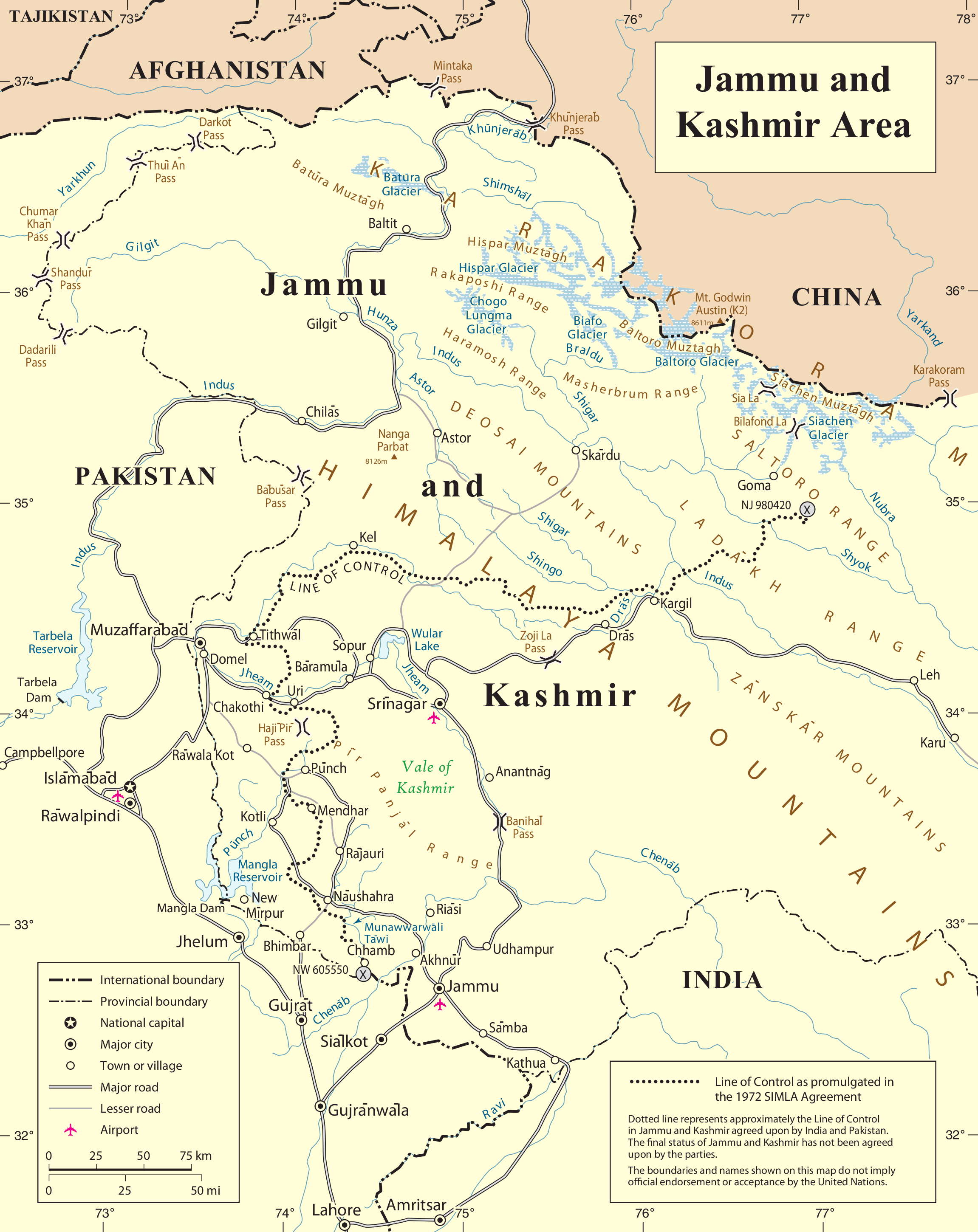
An overview of the geography and topography of the region is in order before we look at geopolitical, military and strategic issues of this conflict.

            Courtesy: The United Nations   (Open in a new tab to see full size)

There are five significant mountain ranges in the J&K state and these are, from east to west, the Karakoram Range (400 miles long), the Ladakh Range, the Zanskar Range, the Great Himalayan Range and the Pir Panjal Range. Of course, there are numerous other minor mountain ranges that branch off these significant five, such as Deosai Mountains, Saltoro,  and Baltoro to name a few. The Karakoram (meaning Black Gravel in Kyrgyz language) Range ends at the Pamir Knot in Central Asia. The sub-ranges of the main Karakoram Range are referred to as muztagh. Thus, for example, we have Siachen Muztagh, Rimo Muztagh and the Sasser Muztagh in the Eastern Karakoram lying to the east and south of the Siachen glacier. The Siachen Muztagh had been explored by the IA during the 1978 to 1981 period (see later for more information). Though these areas have been explored since early 1820s, serious exploration started only in the second half of the nineteenth century as the contours of the Great Game began to take shape. One of the pioneering explorers in the late nineteenth century was Maj. Francis Younghusband who led a British India army unit to capture Lhasa. While the Siachen had been earlier explored by various European expeditions, they all came over the Bilafond La pass in the west. The IA expedition of c. 1978 was the first to ascend it from the Nubra valley through the snout of the glacier. The Indian Army Engineers expedition climbed Rimo IV in 1984. By c. 1985, the IA had almost thoroughly explored the Rimo Muztagh. The Sasser Kangri in the Sasser Muztagh, which is south-east of Siachen, had been first climbed by the IA in 1973 itself.


For full size picture, click here.

It is also instructive to know some other salient geographical features. The Kashmir valley itself lies between the Great Himalayan Range and the PirPanjal Range. The Zoji La pass on the Great Himalayan Range gives an access from the Kashmir valley to Leh in Ladakh through Drass and Kargil. The Chorbat La pass on the Ladakh Range and on the CFL (now, the LoC skirts further north of the Chorbat La after the 1971 war) gives another access to the Shyok Valley to Piun and then to Skardu through Khapalu (the last two in POK. Khapalu is the Brigade HQ for PA's Siachen operations). The 75-Km long and, 1000 feet deep, on an average, 4.5 Km wide (between 2 Kms & 8 Kms at different points) Siachen (meaning, "a place of roses' in Balti) Glacier, the second largest outside of the two polar regions, is situated on the eastern Karakoram Range, buffeted between the Saltoro Range in the South and West and the main Karakoram to the East. The glacier runs diagonally from southeast to northwest.  The Saltoro Range, whose northernmost tip is Sia Kangri (7422m) at less than 5 Kms north of Indira Col (which incidentally is the northernmost point of India today), is nearly 85 Kms long and lies 15 to 20 Kms to the west of the Siachen Glacier. A few kilometres to the east of the easternmost tip of this glaciated region is the strategically important and all-weather Karakoram Pass (5540m) which has been part of the centuries-old Silk Road to Yarkand and beyond. It is near the Karakoram Pass that the world's highest airfield, Daulat Beg Oldie, is located on the Indian side. Karakoram Pass can be reached from Nubra Valley through Sasser Pass and Daulat Beg Oldie.

A few kilometres to the east of the Karakoram Pass begins the Aksai Chin area that China illegally occupied from India in c. 1962. Up North of the Siachen Glacier is the Baltoro Glacier right under the second highest mountain peak in the world, known as K2 or Mount Godwin-Austin. This is close to the ~6000 Sq. Km. Shaksgam Valley (China & Pakistan refer to this area as Trans Karakoram Tract to fudge the historic significance of this area to the state of Jammu & Kashmir)  that Pakistan ceded to China in c. 1963 to enable it to construct the Karakoram Highway  from Kashgar to Pakistan. The Turkestan La pass from Siachen open into the Shaksgam Valley. Earlier, China had also constructed its  National Highway No. 219 whose construction started in c. 1951 as soon as Communist China forcibly established its suzerainty over Tibet . This Highway connected Tibet and Sinkiang (now Xinjiang) surreptitiously through India's Aksai Chin (a length of 230 Kms). In a note to Government of India, the Chinese said, "The Aksai Chin area has always been China's territory; it is the communication artery linking Sinkiang and the Ari District in Tibet of China and has always been under the jurisdiction of the Chinese Government; both in law and fact there is no room for dispute about China's sovereignty over this area." In fact, Pakistan's cartographic aggression and authorizing of foreign mountaineering expeditions was a similar fait-accompli that India wanted not to repeat when it decided to take action. India's fears were confirmed when intelligence (and even a note from a Pakistani Brigadier to his Indian counterpart) also confirmed it.

Further north of the Baltoro is the Rakaposhi Range and then the famous Khunjerab Pass through which the Karakoram Highway reaches Pakistan from China. For these reasons, Siachen is also refrred to as the tri-junction of India, China and Pakistan. The northern-most point of the Siachen Glacier is the Indira Col (or Indira Pass which is named after the Indian Goddess Lakshmi by one of the earliest explorers, the Workman couple in c. 1911 and has nothing to do with Mrs. Indira Gandhi). On the eastern side of the Siachen Glacier are other peaks of the Karakoram (in a west-to-east direction) such as Singhi Kangri (7202m, 'kangri' meaning peak in Balti language), Teram Kangri (7407m), and the Apsarasas Kangri (7236m), The famous Nubra river, among others, originates in the Siachen Glacier at the snout of the glacier near a place called Dzingrulma (where the road to Siachen ends and where India's base camp is located) and joins the Shyok River which itself then drains into the Indus near Skardu in the Baltistan region of Pakistan Occupied Kashmir (POK). The Shyok itself originates from the Rimo Glacier that is connected to the Siachen Glacier through the Teram-Shehr glacier. On the road from Leh to the Nubra Valley is located the Khardung La (Ladakh Range)  pass at 18400 ft. and claimed to be the second highest motorable road in the world. Further to the east of Khardung La is the Chorbat La pass which gives an easier access to the northern Shyok Valley and further to Skardu. Overall, this region is reputed to have over 150 glaciers and is also sometimes referred to as the third pole.

On the Saltoro Range, the highest peak is the Saltoro Kangri. The Saltoro Range itself has five passes, Sia La (northernmost and at 5700m), Bilafond La (also known as the Saltoro Pass at 5547m), Gyong La (at 5500m), Yarma La(at 6100m) and Chulung La (at 5800m). The 110 Km. long AGPL would then start from near Indira Col and then go along the ridge covering peaks and passes southwards in the following order: Conway Saddle, Sia La, Silver Throne (the Baltoro Kangri in POK is known as Golden Throne), Mt. Ghent(7401m), Saltoro Kangri, Bilafond La, Gyong La, Yarma La and Chulung La to Point NJ9842. All the peaks and passes are held by the IA. The backstabbing drama by the PA at Gyong La is all the more a reason why the IA cannot withdraw from Siachen. (See this)

Genesis of the issue

Siachen cannot be looked at in isolation or as a conflict between India and Pakistan alone. India's strategic decisions must be taken in the context also of the boundary dispute between India and China and the developing nexus (since at least c. 1962) between Pakistan and China in the Gilgit-Baltistan (GB) area.

After the 1947-48 war ended due to India taking the issue to the United Nations, the Army commanders of both sides met in Karachi in 1949 to delineate the Ceasrfire Line (CFL). They could precisely delineate the CFL only upto a certain map-grid point, known as Khor or NJ980420. This is a point approximately mid-way between the Nubra and the Shyok rivers between the Ladakh and the Saltoro Ranges and at the southern end of the Saltoro range. The military commanders agreed that the CFL would run "thence north to the glaciers". The Annexure 26 of the UN Commission for India and Pakistan (UNCIP) Report dated July 29, 1949, available here, states the following in Paragraph (B)(2)(d) in Part II titled 'Agreement': From Dalunang eastwards the cease-fire line will follow the general line point 15495, Ishman, Manus, Gangam, Gunderman, Point 13620, Funkar (Point 17628), Marmak, Natsara, Shangruti (Point 1,531), Chorbat La (Point 16700), Chalunka (on the Shyok River), Khor, thence north to the glaciers. This portion of the cease- fire line shall be demarcated in detail on the basis of the factual position as of 27 July, 1949, by the local commanders assisted by United Nations military observers.

It is interesting to note that the Karachi agreement cited above was signed by Lt. Gen Shrinagesh while it was signed by Maj. Gen. J. Cawthorn on behalf of the Pakistani Government. Maj. Gen. J. Cawthorn, a British Army officer of Australian descent, was responsible for effectively setting up the notorious ISID (though he was only its second Director General). He articulated Pakistani positions as to why the state of J&K must be merged with Pakistan in various fora. It is also interesting to note that another prominent member of the Indian team at Karachi drafting this document was Brig. S.H.F.J. Manekshaw (later Field Marshal) who played a very key role in the accession of and later military operations in J&K during 1947-1948.

From even a cursory glance of the maps, one can see that this would then encompass the Siachen Glaciers. During the 1962 India-China war, the US Department of Defense (DoD) offered the services of the USAF pilots to ferry Indian troops to and from the Aksai Chin area, an area that needed overflying the Siachen Glaciers. A few years later, in c. 1967, the Defense Mapping Agency (DMA) of the DoD produced maps known as Tactical Pilotage Charts (TPCs) that indicated the CFL running from Point NJ980420 to the Karakoram Pass (KKP) which is to the east of the Siachen Glaciers. After the 1971 Bangladesh War, the CFL nomenclature had been changed to LoC (Line of Control) as per the Shimla Agreement of 1972 between India and Pakistan. Yet, the LoC remained undemarcated after Point NJ9842. Pakistan began to interpret the term, "thence north to the glaciers" as "thence North East to the Karakoram Pass" while India correctly interpreted that as "thence north (along internationally accepted practice of ridgelines and watersheds forming boundaries between territories) to Indira Col". In the case of river boundaries too, the mid-channel marker (known as thalweg or the deepest water in a stream) is the principle for demarcation. In the Sir-creek issue too, Pakistan is demanding the eastern bank (the Indian side) to be used as the boundary rather than the mid-channel. International boundaries between adjacent countries are not drawn as straight lines when ridges, rivers and watersheds constitute the borderlands. Air Commodore Jasjit Singh has argued that any compromise on the watershed principle could adversely affect India in the resolution of the India-China border issue.

The adjustment of borders between Pakistan and China at this crucial tri-junction has to be also taken into account. Since the border had not been demarcated between British India and China in this area, Pakistan also had a border dispute with the communist China after its independence. Pakistan had made  no progress at all with the Chinese in the border talks up until December 1962, by which time the India-China war had concluded with China having decisively dealt a blow to Indian military. The talks which started in Beijing in May, 1962 had stalled immediately because neither side had any legal records to claim their border alignment. Later, when the talks resumed in Pakistan this time on October 12, 1962, Ayub Khan records in his book, Friends not Masters, how the Chinese were ‘very difficult’ by claiming several areas on the Pakistan side including the Khunjerab Valley and the K-2 mountain peak. The Indo-China War was still more than a week away, October 20, 1962. After the India-China war ended abruptly on November 20, 1962, the Pakistanis were able to immediately find an innovative solution to their vexatious border problem with the Chinese based on the principle of using the watershed of the Indus basin rivers and the traditional grazing grounds used by the Hunza shepherds. Thus, Pakistan conceded vast portions to China, including the Shaksgam Valley. The Official Pakistan Map of 1962 in this area included 11000 Sq. Miles of territory (to the north of the ‘Traditional Frontier’)which has been totally lost by Pakistan to China. Pakistan never staked its claim to these areas in c. 1962, choosing rather to go by the 'Traditional Frontier' several hundred Kms. to the South of the Official Frontier. This is the area bordering Xinjiang (Sinkiang) where the British had built a road all the way from Gilgit in Hunza to Kashgar in Sinkiang where they had a Consulate. In addition, Pakistan conceded another about 3200 Sq. Miles to the south of the ‘Traditional Frontier’ to arrive at the new boundary alignment (out of the 3700 Sq. Miles claimed by China, it was ‘gracious’ enough to give 500 Sq. Miles of cattle grazing ground to Pakistan).

By c. 1978, the IA had setup some camps in the Siachen Glacier itself. In fact, the first landing of a rotary wing aircraft took place on October 6, 1978 in what then was Advance Base Camp II for a casualty evacuation. It was a Chetak that landed at a height of 15,500 ft. to support the exploratory expedition of Col. Narender 'Bull' Kumar after whom the Siachen base camp has been named by the IA. The camp exists at the same place where the c. 1981 Army expedition team led by Col. Narender 'Bull' Kumar set up their Advanced Base Camp at the confluence of the K12 and Siachen glaciers. It is from here that his expedition climbed the Bilafond La pass, Indira Col, Turkestan La, Sia Kangri, Sia La, and the Saltoro Kangri and mapped them precisely for future use. (See this)

It was on April 13, 1984, almost 28 years to the day before the latest Gyari avalanche disaster, that India launched Operation Meghdoot in an audacious and daring operation very reminiscent of  Operation Duck to rid the 3500m. high Zoji La pass of the Pakistani intruders and save Ladakh from falling into Pakistani hands in c. 1948. In c. 1983, India has intelligence information that Pakistan had assembled a special group, the Burzil Force, to capture Saltoro and Siachen beyond that. In fact, a protest note from the Pakistani FCNA (Force Commander Northern Area) to his Indian counterpart on August 16, 1983 had claimed that Indian territory extended in this sector only up to the Karakoram Pass. This followed the citing of some troops of Indian Army's Ladakh Scouts on the glacier by the SSG troops of the PA. Based on this protest note and the intelligence, the IA came to the conclusion that the only way to thwart this aggression would be to occupy the heights and the passes on the Saltoro and thus was Op. Meghdoot planned. We now know from the accounts of Lt. Gen. Jahan Dad Khan, the then Corps Commander of the Rawalpindi-based X Corps of the PA (through his book, 'Pakistan Leadership Challenges', Oxford University Press, 08 July 1999) which was responsible for Force Command Northern Areas (FCNA) responsible for this sector, that the PA was preparing to seize Saltoro and Siachen in 1984 and the operation had been cleared at the highest levels. By c. 1983, Pakistan had access to nuclear weapons, thanks to Chinese proliferation, and they were emboldened to launch this adventure in Saltoro. Pakistan's use of terrorism against India under a nuclear overhang, in the Indian Punjab, the state of J&K and later all over India and even Indian interests abroad bear out the truth that Pakistan's proposed military action in c. 1984 in the Saltoro/Siachen area was indeed on the back of newly acquired nuclear weapons.

The last major PA assault on Indian positions on the Saltoro ridge happened way back in c. 1992. It was, like all previous assaults, unsuccessful. It was in April 1987 that the SSG Commandos of the PA occupied a position overlooking the Bilafond La pass. This poistion was called the 'Quaid Post' by the PA. On June 25, 1987, the IA overran the Quaid Post and evicted the PA, an operation in which Bana Singh was given the highest award of Param Vir Chakra (PVC).  In September, 1987, a certain Brig. Musharraf of the SSG attempted to capture certain salients in Bilafond La. It was a terrible disaster when a few hundred Pakistani soldiers died and a very hurt Musharraf decided to avenge it in c. 1999 when he launched an even more disastrous Kargil operation. In March 1989, Pakistan made another attempt through the Chumik glacier (near the now extinct Giyari base) but even that could not succeed. However, the Indian and Pakistani army commanders came to an understanding after this incident that neither side would occupy the difficult heights of the Chumik and this has been respected ever since. In November, 1992, the FCNA Maj. Gen. Zahir-ul-Islam Abbassi authorized another operation. This atempt led to the death of dozens of PA soldiers, as a result of which, Maj. Gen. Abbassi was stripped of his post by the then COAS, Gen. Asif Nawaz Janjua. As an aside, Gen, Abbassi later tried in September 1995 to stage a military coup with the help of the noted terrorist Qari Saifullah Akhtar of Harkat-ul-Jihadi-Islami (HuJI). After serving a minimum sentence, he was released in c. 1999 by Gen. Musharraf when he usurped power from Nawaz Sharif. Abbassi then joined Sipah-e-Sahab Pakistan (SSP) to work tirelessly for establishing a Caliphate.

When he launched the Kargil operation, Gen. Musharraf would have known that the major powers would intervene rapidly in a war launched with India, an idea that he welcomed as an opportunity to further internationalize the Kashmir issue. At the same time, the idea of Gen. Musharraf was to re-capture the areas lost during the 1971 war (such as Thang, Pachthang, Thyakshi, Chalunka and Turtok along the Shyok river), cut-off Leh from Kashmir and create a logistics vacuum for the Siachen -based IA brigade before the intervention of major powers resulted in a ceasefire. Gen. V.P.Malik, the then Chief of Army Staff (COAS) of the Indian Army during the Kargil War says in an interview "I feel the failed Siachen operations hurt Musharraf  more than they did anyone else, as well as other actions involving him that failed." as the reasons that prompted the Kargil misadventure. Evidence such as the then Pakistan Foregin Minister Sartaj Aziz's statement in London in early July, 1999  linking Pakistani troop withdrawal from Kargil to IA's withdrawal from Siachen and Saltoro confirms Gen. V.P.Malik's assessment. A PAF Officer, Kaiser Tufail, who was part of the planning, has this to say about the Kargil operation:


The target was a vulnerable section of the Dras-Kargil Road, whose blocking would virtually cut off the crucial life-line which carried the bulk of supplies needed for daily consumption as well as annual winterstocking in the Leh-Siachen sector. He [Lt. Gen. Mahmud Ahmed, GOC, X Corps and later to become the Chief of the ISI until he was relieved of his post for being a double-agent of the Afghan Taliban & Al-Qaeda. He has many other credits as well. He allowed Ahmed Al-Khadir, who bombed the Egyptian Embassy in Islamabad in November, 1995 to escape from a safe house with the help of the Taliban  in Peshawar; wire-transferred USD 100,000 to the WTC terrorist Mohammed Atta  through terrorist  Ahmed Omar Saeed Sheikh; he was tasked by the US to talk to the Taliban to hand-over Osama bin Laden but instead, he asked them to resist the US; he was a part of the 'Gang of Four' who brought Gen. Musharraf to power ousting Nawaz Sharif ] was very hopeful that this stratagem could choke off the Indians in the vital sector for up to a month, after which the monsoons would prevent vehicular movement (due to landslides) and, also suspend all airlift by the IAF. “Come October, we shall walk in to Siachen – to mop up the dead bodies of hundreds of Indians left hungry, out in the cold,” he succinctly summed up what appeared to be a new dimension to the Siachen dispute.
Circumstantial evidence such as the eleven attempts made by the PA to capture ridgelines and salients in the Saltoro Range in c. 1998 also add to the evidence. Accompanying his Prime Minister Nawaz Sharif for talks with the British Prime Minister Tony Blair on the Kargil situation, he said, "Pakistan has agreed to request and appeal to the freedom fighters to withdraw from Kargil if India also agrees to vacate the areas that it occupied on the LoC after the signing of the Simla Agreement."

India uses helicopters such as the Cheetah,  ALH Dhruv Mark IIIs or even the much bigger MI-17 VIs (which can now fly upto 18000 ft.) for logistics from the base camp to the various posts dotting the Siachen and the Saltoro. The supply line starts from Chandigarh to the Thoise airbase ('Thoise' is an acronym that stands for Transit Holding Of Indian Soldiers Establishment)  in the Shyok Valley. Thoise falls under the Partapur sector of the Indian Army. The supply line employs the giant IL-76s, AN-32s, MI-17s, the Dhruvs and the ubiquitous Cheetahs at different stages.

Why does the Indian Army distrust the PA ? In December 1948, India vacated the pickets on the important Haji Pir Pass that connects Punch and Uri. The PA promptly occupied them even as the Cease Fire went into effect from Jan 1, 1949. It was with great difficulty and a lot of sacrifices that the IA re-took the Haji Pir Pass in the 1965 war but in the talks in Tashkent, India returned it to Pakistan. In Kargil and other areas which are clearly delineated and agreed to by both the parties after the 1971 war, the IA has been withdrawing pickets during the winter since c. 1982 and in c. 1998, the PA surreptitiously occupied all the vacated heights prompting a bloody war.  Even galciated salients in the Kargil sector which IA commanders assumed that the PA would not occupy were found to have been occupied. Now, China says that in order to celebrate the 'long-term friendship with Pakistan', they will be sending an expedition to the Boltoro glacier in June/July timeframe.  It is therefore inconceivable for the IA to vacate the Saltoro and Siachen posts, especially when China's People's Liberation Army (PLA) has begun to be present in large numbers in Balawaristan after c. 2008, hoping that the invidious and perfidious PA would somehow abide by any agreement that may be arrived at authenticating the ground position. This is especially important considering the fact that in the negotiations in c. 2011, the Pakistani Defence Ministry representatives pushed India to include Chinese representatives in the discussion because China was controlling the nearby Shaksgam Valley.

What do the protagonists of de-militarization say ?
  • “low-hanging fruit” of the India-Pakistan peace process

    Certainly, Siachen cannot be the 'low-hanging fruit' to be plucked first before attempting to resolve the weightier issues. With border delineation between India and China not yet resolved after sixty years of negotiations (and a war), with Pakistan ceding an important area of Kashmir (the Shaksgam Valley abutting the Siachen glacier in the north) illegally to China, with increasing presence of the Chinese PLA troops in the sensitive Gilgit-Baltistan area, with the expressed desire of the PLA to come to the Baltoro glacier abutting the northern Siachen on the west, with Pakistan claiming the Indian border to end at the Karakoram pass citing the 1963 Pakistan-China agreement thus establishing clearly a collusion between these two nations in map and border making at the cost of India, and with the knowledge of the Pakistani propensity to be fraudulent and completely untrustworthy, the Siachen cannot be a 'low-hanging fruit' at least from an Indian perspective. After all, the entire state of Jammu & Kashmir as it existed on October 26, 1947 belongs to India. Then, why should India negotiate separately for Siachen alone ?
  •  Occupation of Siachen contributes to global warming

    It may or may not be. I do not know this for a fact one way or another. The biggest contributors to global warming are the Western powers, especially the USA, which also seems to be at the forefront of blunting Indian military advantage in Saltoro. It has been the US which in the last sixty years of its reckless support for a state like Pakistan, has brought the whole world to the brink of disaster. The Siachen impact on ecology, even if it were to be true, pales into insignificance in comparison to Pakistan's jihadi terrorism and nuclear proliferation and the US' support for these two activities since at least the 1970s. 
  • It is possible to de-militarize Siachen/Saltoro in a fool-proof manner using technology. (See this)

    As noted elsewhere in this blog, there is no fail-safe and fool-proof technology available to monitor troop movements in these areas. Those who occupy the peaks, salients, passes will dictate terms. India enjoys an enormous advantage here, thanks to the sacrifices of thousands of its brave soldiers over nearly 30 years and the brilliant mountaineering expeditions of a group of dedicated army officers and rank & file in the 70s and the 80s.
  • The Siachen conflict is a cruel, costly and unnecessary war that must be brought to an end.

    This is the most humbug statement I have come across. Every war is cruel, costly and unnecessary from one viewpoint or another. How is the Kashmir War (in its various manifestations since 1947) less costly or less cruel or more justified ? How is Partition of India
    not cruel, costly or justified ?
What do the Pakistanis say ?
      •  Pakistan cannot authenticate any AGPL because it was India that aggressed and should not have been where it is now.
           
        This is a hollow argument for two reasons. One, Pakistan and its Cold-war ally, the USA, had already committed cartographic aggression by depicting in the maps that the Siachen area belonged to Pakistan. Further, Pakistan had made all preparations to mount a military assault on Saltoro and Siachen in c. 1984. India got wind of the impending action and simply pre-empted them by a few days. The local Pakistani commander was waiting for a warmer weather according to Shuja Nawaz, the brother of ex-Pakistani COAS, Gen. Asif Nawaz Janjua, in his book, 'Crossed Swords'. As already noted, the Rawalpindi Corps Commander of c. 1983, Lt. Gen. Jahan Dad Khan has written how an operation similar to Op. Meghdoot had been planned by the PA for May 1984. The IA simply staved off Pakistani aggression on Indian territory and cannot therefore be equated to aggression.

      • Pakistanis also refer to India unilaterally altering the LoC in Siachen, thus violating the Simla Agreement. Pakistan cannot put on this face of 'injured innocence' in light of its designs on this area since long, first by trying to create a fait-accompli by 'authorizing' mountaineering expeditions from Europe, Japan and Australia, later by altering maps, then by trying to send its army patrols in this area and finally planning to capture it through force in May 1984.

      • There is no reference to "thence north to the glaciers" in the 1972 Shimla Agreement.

        There is some confusion by the ambiguous set of words. It says "From there, the line of control runs northeastwards to Thang (inclusive to India) thence eastwards joining the glaciers" (See this)

        Though the wordings appear to be unfortunate, we will shortly see why the seeming contradiction is not really one.


        Even the 1965 Tashkent Agreement does not refer to "thence north to the glaciers" because the troops were agreed to be withdrawn to the CFL determined by the 1949 CFL. It therefore firmly recognized the agreement reached in Karachi in 1949. However, after the 1971 war on the western front, the two sides decided to retain whatever areas they captured. This resulted finally in the CFL being re-designated as LoC and a new alignment to the east of NJ9842. The Simla Agreement refers to the new Indian Position of Thang from where the LoC does run eastwards to NJ9842. This was what the Shimla Agreement meant when it said 'eastwards'. However, there was never any doubt about the termination point of NJ9842 because it was well recognized and accepted. There was no fighting to the east or north of Pt. NJ9842 in 1971 and therefore the question of not respecting the then existing CFL (Cease Fire Line resulting from the 1949 Karachi Agreement) beyond NJ9842 or altering it in these areas beyond that point simply does not arise.

        Shimla Agreement also said,
        ". . . in Jammu and Kashmir, the Line of Control resulting from the ceasefire of December 17, 1971, shall be respected by both sides without prejudice to the recognised position of either side. Neither side shall seek to alter it unilaterally, irrespective of mutual differences and legal interpretations. Both sides further undertake to refrain from the threat or the use of force in violation of this Line."
        We now know that India only pre-empted the Pakistani aggression by a mere three or four days, as acknowledged by Pakistani Army officers themselves. Therefore, the claimed Pakistani high-moral-ground is humbug and hollow.

         When war ended in c. 1971, India held 5800 Sq. Kms of Pakistani territory while Pakistan held a mere 110 Sq. Kms of Indian territory on the western front. Besides, the demarcations referred to in the Karachi Agreement must hold for the same reason in this sector after the 1972 Shimla agreement also because no country, especially a country that decisively defeated the Pakistani Army which resulted in more than 50% of its territory and population seceding within a matter of a mere fortnight, and which held 93000 of Pakistani soldiers as Prisoners of War (PoWs), gives up an area (Siachen) of roughly 2000 Sq. Kms. where there was no fighting at all. Besides, the new LoC recognized only the ground realities after the war and Saltoro and Siachen were not part of these new realities. It is therefore unthinkable that an area of almost 2000 Sq. Kms would have been simply gifted away by an all-conquering army to an all-defeated army.This behaviour of the PA is quite reminiscent of its behaviour during the Shimla negotiations in 1972. It asked its President (the then Chief Martial Law Administrator, CMLA), Zulfiqar Ali Bhutto to demand the following from India:
        Withdraw Indian troops from all occupied areas of West Pakistan & POK
        Return all the PoWs held by India without any trial for war crimes
        Demand settlement of the Kashmir issue in accordance with the wishes of Kashmiris
        Demand reduction in the size of India's armed forces to remove the Pakistani fear of aggression by India
        No exchange of territory that could give India a strategic or tactical advantage in future conflicts.

        Shuja Nawaz says in his book that this did not look like 'an army that had just lost a war. It sounded more like the terms of surrender offered to a defeated enemy'.

        Besides, there has been no question about Nubra Valley and a part of the Shyok Valley being naturally part of the Ladakh region.

      • India reneged on the Siachen Agreement.
        Somehow, Pakistanis maintain that a framework for an agreement to de-militarize Siachen was agreed upon during India Prime Minister Rajiv Gandhi's tenure in c. 1989 but India has resiled from that later on by introducing a new condition of demanding authentication by Pakistan of actual ground position. Even as early as c. 1992, India had denied that there was any final agreement and stated that both sides had only agreed "to carry forward the process of discussions [in 1992], which had remained suspended since June 1989". In the June 1989 Siachen talks, India's position was this:
        India demanded cessation of Pakistan's cartographic aggression of unilaterally extending the LoC from NJ9842 to the Karakoram Pass
        India demanded a demilitarized zone (DMZ)
        Exchange of authenticated maps between GoI and GoP reflecting the existing ground realities.Re-deployment of IA and PA to mutually agreed positions

        Pakistan agreed to mutually agreed re-deployment positions of troops but they insisted the troops to be re-deployed to their 1971 ceasefire positions and wanted delimitation of the LoC beyond NJ9842 through talks and not based on ground realities.

        The Pakistani demands were clearly unacceptable even to an India which wanted to be flexible as a new Prime Minister, Ms. Benazir Bhuto, had just been elected democratically after a long military rule. But, clearly, no agreement could be reached as the Pakistani military never allowed civilian oversight in these matters. The joint statement at the end of the 1989 talks said,
        There was agreement by both sides to work towards a comprehensive settlement, based on redeployment of forces to reduce the chance of conflict, avoidance of the use of force and the determination of future positions on the ground so as to conform with the Simla Agreement and to ensure durable peace in the Siachen area

        The above is a vague statement running a middle line through the stands of the two governments. Pakistan is simply latching on to the third word in the above statement, namely, 'agreement' to claim as though there was an agreement.
        When Pakistan speaks of India reneging on a non-existent agreement, one is only reminded of Pakistani behavior in the light of UNSC resolution asking Pakistan to vacate J&K, its agreement in May 1948 to pay seignorage charges to India for waters through headworks in India and its immediate default, its non-settlement of partition dues to India till date, its repudiation of LoC during the Kargil conflict, its frequent violation of the 1972 Simla Agreement in various forms including sponsoring terrorism against India, its perfidious actions against the UNSC sanctioned terrorist Hafeez Saeed etc. Such is Pakistan's reputation that when it speaks of another country violating an agreement, it would not be taken seriously.
     Pakistan's "Joining two authentic points i.e. Pt NJ 9842 and KKP, duly recorded in  international agreements since 1949 and 1963" and "numerous books and atlases as far back as 1965" record them and therefore cannot be 'cartographic aggression'.
      The 1949 agreement is presumably the Karachi agreement and it beats one's credulity when somebody claims that 'thence north to the glaciers' is equivalent to 'thence south-east to Karakoram Pass". The 1963 agreement is between Pakistan and China, who partook Indian territory and therefore by no stretch of imagination, even by Pakistani standards, can it be called an international agreement authenticating Pakistani position. Such an agreement does not bind India and India does not recognize this agreement. It is a circular argument by Pakistan to refer to maps and its bilateral treaty with China in its territorial disputes with India. In fact, such references1963 China-Pakistan Boundary Agreement only buttress the Indian stand of not withdrawing from Siachen at all, When India and Pakistan themselves had not demarcated a portion of their border, how can map makers sitting in Europe and the US decide on it and how can that be binding on India ?